

A content calendar that serves every format: A model for B2B marketers

In many B2B organisations, the content calendar appears well managed at first glance. Publishing dates are in place, responsibilities have been assigned and channels are filled at a steady pace. Yet marketing leaders and content teams often share the same familiar feeling: a great deal of content is being produced, but it is difficult to tell whether the organisation is building a long term content system or simply maintaining a continuous publishing rhythm.
The issue is rarely a lack of effort or poor quality content. More often, the problem lies in how the calendar is structured. Content calendars are commonly built around channels rather than themes. The blog needs one topic, LinkedIn another and the newsletter its own angle. As a result, the same subject is discussed across multiple places without a shared structure, or topics are constantly changed simply to avoid “repeating ourselves”.
This is where many B2B teams run into a misleading assumption: overlapping content is not the problem. Unplanned overlap is.
An effective content calendar is not a publishing list, but a content system
Inside the organisation, every piece of content is visible. Buyers, however, only encounter fragments of it. One person comes across a LinkedIn post, another opens a newsletter, while a third discovers an expert article through search months later. Very few people experience content in publishing order or through the same channels. That is why the role of a content calendar is not to prevent the same theme from appearing in multiple formats. Its purpose is to create several meaningful touchpoints around a single theme for different situations and audiences.
A traditional content calendar answers the question of what will be published and when. In B2B marketing, that is no longer enough. A more effective approach is to build the calendar around strategic themes. Instead of planning individual pieces of content one by one, the organisation first defines the broader topic area and only then determines the role of different formats within it. In practice, the calendar shifts from being a publishing spreadsheet to becoming a structured content system.
An effective content calendar should include at least the following elements:
- Theme and business objective: Which strategic theme does the content support, and what business objective is it connected to?
- Core format or pillar content: What serves as the foundation of the content initiative? This could be a guide, research report, webinar or expert article.
- Supporting formats: How is the core content broken down into smaller assets? LinkedIn posts, blog series, newsletters, video clips, FAQ content and sales materials can all be built around the same central idea.
- Target audience and buying journey stage: Who is the content intended for, and at which stage of the buying journey is it needed?
- Channels and distribution: Where will the content be published, and how will visibility be ensured?
- Responsibilities and timelines: Who is responsible for producing, approving and publishing the content?
- Metrics: How will impact be evaluated? Are you measuring traffic, leads, downloads or commercial impact?
When these elements are visible in one place, the content calendar begins to support the entire marketing process rather than individual publications alone.
A model for a B2B content calendar
The model below demonstrates how a single strategic theme can be developed into multiple formats without treating each piece of content as a separate project.
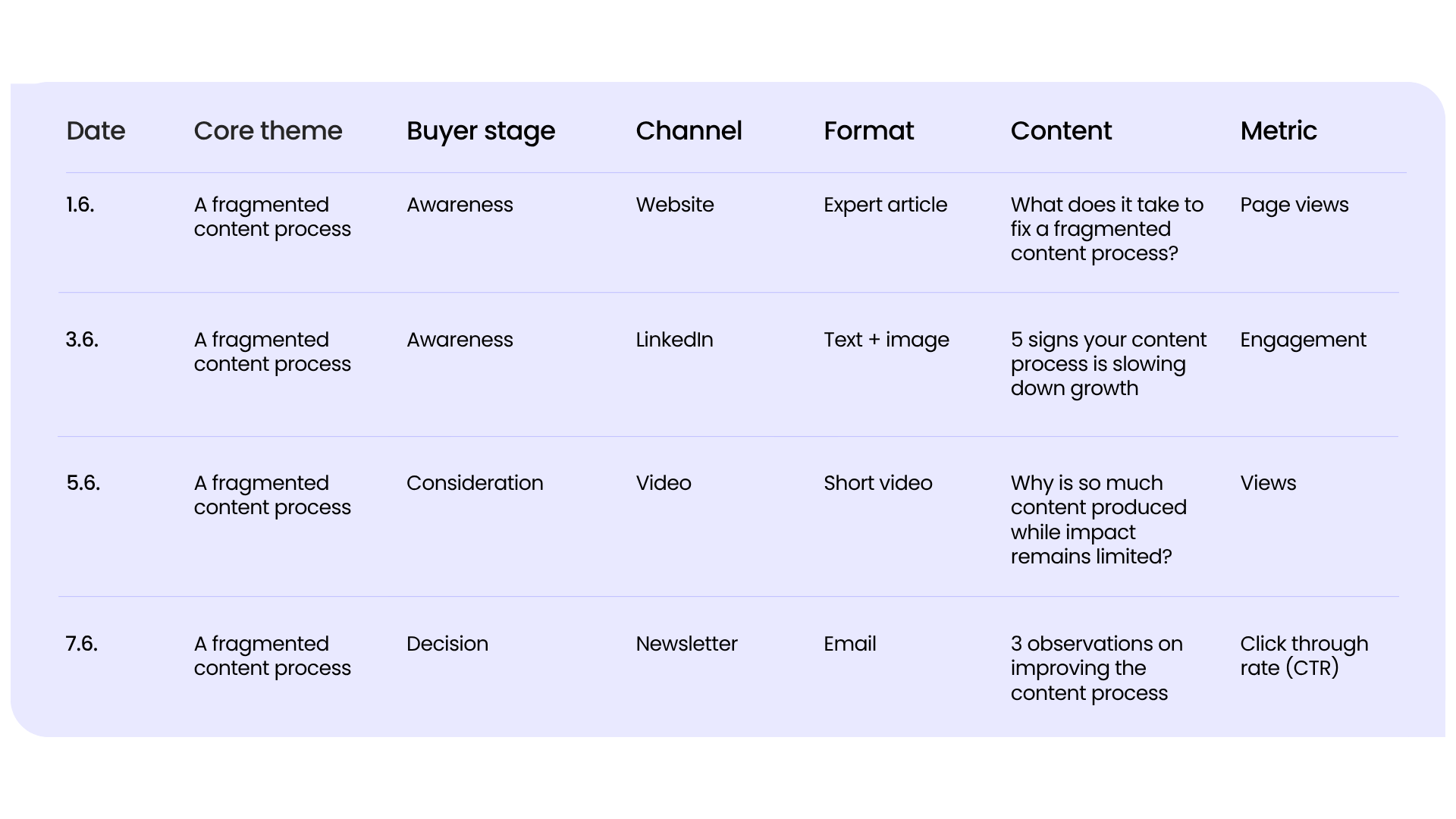
A content calendar is a strategic leadership tool
A content calendar is often seen as an operational tool, but in reality it reveals a great deal about how an organisation approaches marketing. Is content created to serve the needs of individual channels, or is it managed as one connected system?
A well structured content calendar is not something customers experience as a spreadsheet or publishing plan. What they experience instead is consistency: the right messages reaching the right people in the right situations. Individual pieces of content no longer feel like isolated publications, but like parts of a larger and more cohesive whole.
The real value of a content calendar does not come from helping teams publish more content or simply keeping channels active. Its most important role is to make visible what the organisation is actually building through content. At the same time, it creates a shared view across marketing, sales and customer success teams. When upcoming content is visible across teams, it can be used in the right situations at the right time, connected to sales activities and integrated more naturally into customer interactions.
If the goal is merely to fill next week’s publishing slots, content easily becomes a series of disconnected actions. But when the goal is to build expertise, increase demand and create long term visibility, the role of the content calendar changes entirely. It is no longer just a production management tool, but a framework that connects different formats, channels and customer touchpoints around a shared objective. Ultimately, that is the difference between simply managing content and leading it strategically.
Are you measuring your content at the right time?
A results-driven content strategy needs a clear view of what different content types can actually achieve. Download our free cheat sheet and find out the stages and lengths of review timelines for each content type, which metrics to track at each stage and what conclusions you can draw from the data at each point.